
Your Food Noise Pattern
You're an Emotional Eater
You don't only eat because you're hungry.
You eat because you're stressed, bored, lonely, overwhelmed, or just because the day was a lot.
The kitchen becomes your decompression zone, and afterwards, you feel worse than before.
What this pattern is actually costing you
-
The eating isn't random — it's predictable. Hard day, kitchen, regret, repeat. Every time it happens you promise yourself "not again," and every time the next stressful evening arrives, the pull is stronger than the promise. The weight accumulates in the background while you're busy managing everything else.
-
You don't have another reliable way to decompress after a full-on day. Wine, scrolling, food — they're not treats, they're coping mechanisms. And the more you rely on food to regulate your emotions, the less capable you feel of handling stress without it. The toolkit is shrinking, not growing.
-
It's not just the eating — it's the secrecy. Eating standing up in the kitchen after everyone's gone to bed. Hiding wrappers. Feeling like a fraud because you're competent at everything else but this. That shame doesn't motivate change. It drives more eating.
-
Every diet you've tried has focused on what you eat. Nobody has helped you with why you eat. So you keep trying to fix a psychological problem with a nutritional solution — and wondering why it never sticks.
Your 3-Step Action Plan
Start these today. They won't eliminate emotional eating overnight, but they'll start breaking the automatic loop.
Name what you're actually feeling before you open the cupboard
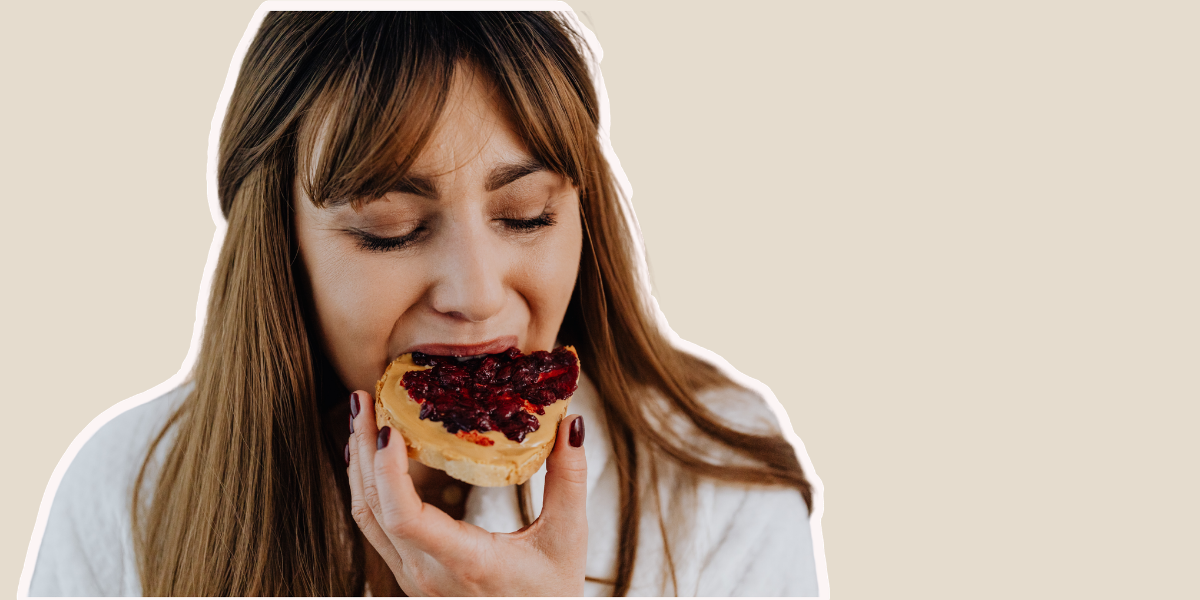
Emotional eating works because it's fast.
The gap between "I feel something" and "I'm eating" is almost instant. Your job is to slow that gap down, even by 30 seconds.
Before you reach for food outside of a meal, pause and ask: "Am I hungry, or am I feeling something?" You don't have to stop eating. Just name it. Tired. Annoyed. Lonely. Overwhelmed. Bored.
The naming interrupts the autopilot.
Try this: Stick a post-it on your kitchen cupboard that says "Hungry, or something else?" It sounds simple. It works because it creates a pause where there wasn't one.
2. Build a 10-minute buffer that isn't food. Surf The Urge.
You need something between "I want to eat" and actually eating. Not forever, just 10 minutes. Enough time for the sharpest edge of the urge to pass.
This isn't about distraction or willpower. It's about giving your brain a genuine alternative.
Walk to the end of the garden. Run hot water over your hands. Put headphones on for one song. Change rooms. The urge will still be there afterwards, sometimes. But often, 10 minutes is enough for it to lose its grip..
Try this: Write down three things you could do for 10 minutes that aren't eating. Keep the list on your phone. When the pull comes, pick one. If you still want to eat afterwards, eat — but do it sitting down, on a plate, slowly.
3. Check you're actually eating enough during the day
Here's the thing nobody talks about: most emotional eaters are also under-eating during the day. You skip breakfast, have a light lunch, power through on coffee, and then wonder why you can't stop eating at 9pm. Your body isn't being dramatic. It's genuinely hungry.
And when physical hunger meets emotional tiredness, food becomes the only answer. Eat proper meals during the day, with enough protein and enough volume, and the evening pull loses half its power.
Try this: For one week, eat three proper meals with protein at each one. Don't change anything about your evening eating. Just add daytime fuel and see what shifts.
These steps will help. But here's what you probably already sense.
Understanding why you eat emotionally doesn't stop you eating emotionally.
You've probably known for years that you eat your feelings. The problem was never awareness, it's that awareness alone doesn't change the behaviour. You need to build new skills, new responses, new ways of handling the end of a hard day that don't involve the kitchen cupboard. That takes practice, not just insight.
That's exactly what Fat Loss Without The Chaos is designed to do.
Fat Loss Without The Chaos
6 weeks. Self-paced. Lose weight without another diet, because we fix what's actually keeping you stuck, not just the food on your plate.
✓6 modules that build skills, not more rules to break
✓Async email coaching with Georgia (founding members only)
✓Completely private — no group calls, no Facebook group
✓Built for women who work and don't have spare hours
£197
Founding member price (will be £297 after launch)
Use code AFXLDCP at checkout
10 founding member spots. Cart closes Friday 13 March at 5pm.
Complete all 6 weeks and don't feel a shift? Georgia will upgrade you to her 1:1 Dieting Differently coaching at no extra cost. You don't risk anything except staying exactly where you are.
Not ready yet? No pressure. Get Georgia's weekly Substack, weight loss without the chaos, straight to your inbox.